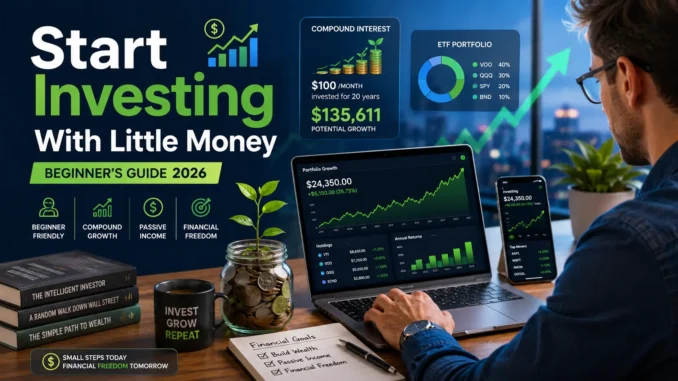
Let’s be honest — most people think investing is something only rich people do.
You probably grew up hearing things like “save your money” or “don’t spend what you don’t have.” But nobody sat you down and explained how to actually grow that money.
Here’s the hard truth: if you’re only saving, inflation is quietly eating your wealth alive. In 2026, with the average U.S. inflation rate hovering around 3–4%, money sitting in a regular savings account loses purchasing power every single year.
So if you’ve been wondering how to start investing with little money, you’re asking exactly the right question—and you’re in the right place.
This beginner’s guide will walk you through everything: where to start, which accounts to open, what to invest in, and how to avoid the costly mistakes that trip up most first-time investors. Whether you have $50 or $5,000 to start with, this guide is built for you.
Let’s get into it.
Why Most Americans Never Start Investing (And Why That’s Costing Them Thousands)
According to a 2024 Gallup poll, nearly 56% of Americans do not own any stocks. That number is staggering — especially when you consider that the S&P 500 has historically returned an average of ~10% per year over the past century.
Why do people hold back? Usually it comes down to three myths:
- “I don’t have enough money to invest.” — False. Many platforms let you start with as little as $1.
- “It’s too complicated.” — False. Passive index fund investing takes about 20 minutes to set up.
- “It’s too risky.” — Partly true, but inaction is also a risk. Not investing is a guaranteed way to fall behind.
The real risk isn’t losing money in the stock market. The real risk is doing nothing for 20 years and waking up at 65 without enough to retire on.
Step 1: Get Your Financial House in Order First
Before you invest a single dollar, you need a solid foundation. Investing on top of financial chaos is like building a house on sand.
Build a Starter Emergency Fund
Financial experts—including Dave Ramsey and Suze Orman—universally agree: you need an emergency fund before you invest.
Aim for at least $1,000 to $2,000 saved in a high-yield savings account (HYSA). Later, you’ll grow this to 3–6 months of living expenses.
Top HYSAs in 2026 are paying 4.5–5.25% APY — far better than a traditional bank’s 0.01%.
Pay Off High-Interest Debt First
If you’re carrying credit card debt at 20–29% APR, paying that off is the best guaranteed investment you’ll ever make. No stock market return beats eliminating 25% interest debt.
The general rule of thumb:
- High-interest debt (above 7%) → Pay it off before investing aggressively
- Low-interest debt (below 4%) → You can invest while making minimum payments
Set a Monthly Investment Budget
You don’t need a lot. Start with what you can. Even $25–$50 a month invested consistently can grow into tens of thousands of dollars thanks to compound interest.
Quick Example: $100/month invested for 30 years at 8% annual return = $149,000+. Start 10 years later, and that drops to just $54,000. Time is your most valuable asset.
Step 2: Understand the Types of Investment Accounts
This is where most beginners get confused — and it matters a lot because the account type determines how much you get to keep after taxes.
401(k) — Your Workplace Retirement Account
If your employer offers a 401(k) with a matching contribution, this is your #1 priority. Employer matching is essentially free money — a 100% instant return on your investment.
Key facts:
- 2026 contribution limit: $23,500 (under 50) / $31,000 (50+)
- Traditional 401(k): pre-tax contributions, taxed on withdrawal
- Roth 401(k): after-tax contributions, tax-free withdrawals in retirement
- Always contribute enough to get the full employer match first.
Roth IRA — The Holy Grail for Beginners
The Roth IRA is arguably the single best investment account for beginners in the U.S. Here’s why:
- Your money grows 100% tax-free
- Withdrawals in retirement are tax-free
- You can withdraw your contributions (not earnings) at any time without penalty
- 2026 contribution limit: $7,000/year ($8,000 if age 50+)
- Income limits apply: phase-out begins at $146,000 (single) / $230,000 (married)
If you’re in your 20s or 30s, the Roth IRA is one of the most powerful wealth-building tools available. Open one. Fund it. Don’t touch it.
Traditional IRA
Similar to a Roth IRA, contributions may be tax-deductible now, and you pay taxes on withdrawal in retirement. Better suited for people who expect to be in a lower tax bracket during retirement.
Taxable Brokerage Account
Once you’ve maxed out your Roth IRA and 401(k), a taxable brokerage account lets you invest with no contribution limits. You’ll pay capital gains taxes on profits, but it gives you flexibility and access to your money at any time.
Step 3: Choose the Right Investment Platform
The good news? Opening an investment account has never been easier or cheaper. Most major platforms charge zero commissions on stock and ETF trades.
| Platform | Best For | Minimum to Start | Standout Feature |
|---|---|---|---|
| Fidelity | Overall beginners | $0 | Fractional shares, great research tools |
| Charles Schwab | Long-term investors | $0 | 24/7 support, no-fee index funds |
| Vanguard | Index fund investors | $0 (ETFs) | Creator of index funds, ultra-low fees |
| Robinhood | Young, mobile-first investors | $1 | Simple interface, fractional shares |
| M1 Finance | Automated investing | $100 | Automated pie investing, free rebalancing |
| Betterment | Hands-off beginners | $10 | Robo-advisor, automatic rebalancing |
Recommendation for beginners: Start with Fidelity or Schwab. Both are reputable, have zero minimums, offer fractional shares, and have exceptional educational resources.
Step 4: Learn What to Actually Invest In
Now for the fun part — what do you actually buy?
Index Funds: The Beginner’s Best Friend
An index fund is a basket of stocks that tracks a market index — like the S&P 500 (the 500 largest U.S. companies).
Instead of trying to pick winning stocks (which even professional fund managers fail to do consistently), you buy the whole market.
Why index funds are great for beginners:
- Instant diversification — you own hundreds of companies with one purchase
- Extremely low fees (expense ratios as low as 0.03%)
- Historically outperform actively managed funds over time
- No research, no stock-picking, no stress
Top index funds to consider:
- FSKAX (Fidelity Total Market Index Fund) — 0.015% expense ratio
- VTSAX (Vanguard Total Stock Market Index Fund) — 0.04% expense ratio
- SWTSX (Schwab Total Stock Market Index) — 0.03% expense ratio
- VOO (Vanguard S&P 500 ETF) — 0.03% expense ratio
ETFs vs. Mutual Funds
Both index funds and ETFs (Exchange-Traded Funds) track an index — the main difference is how they’re traded.
- Mutual funds are bought/sold once a day at the closing price
- ETFs trade like stocks—you can buy/sell throughout the day
For most beginners, it doesn’t matter much. Both are excellent. ETFs are often preferred for taxable accounts due to slightly better tax efficiency.
Stocks: Proceed With Caution
Buying individual stocks can be exciting, but it’s also risky. A single company can lose 50–80% of its value seemingly overnight.
If you do buy individual stocks:
- Never put more than 5–10% of your portfolio into any single stock
- Only invest money you can afford to lose
- Focus on companies you understand
- Think long-term — at least 5 years
Bonds: The Stability Play
Bonds are loans you make to governments or corporations in exchange for regular interest payments. They’re safer than stocks but generate lower returns.
General guideline: The younger you are, the fewer bonds you need. A common rule is “your age in bonds”—so a 25-year-old might hold 25% bonds and 75% stocks. Many modern experts think this is too conservative for today’s longer lifespans.
REITs: Real Estate Without the Landlord Headaches
A Real Estate Investment Trust (REIT) lets you invest in real estate through the stock market — no buying property, no tenants, no repairs.
REITs are required to pay out at least 90% of taxable income as dividends, making them attractive for income-seeking investors.
Step 5: Master the Core Investing Principles
Knowing what to buy is only half the battle. How you invest matters just as much.
Dollar-Cost Averaging (DCA): Invest Consistently, Not Perfectly
Dollar-cost averaging means investing a fixed amount of money at regular intervals — regardless of whether the market is up or down.
This removes emotion from the equation. You buy more shares when prices are low and fewer when prices are high, resulting in a lower average cost per share over time.
Example:
- Month 1: Invest $200 when share price is $50 → get 4 shares
- Month 2: Market drops. Invest $200 when price is $40 → get 5 shares
- Month 3: Market recovers. Invest $200 at $50 → get 4 shares
- Total: $600 invested, 13 shares, average cost = $46.15/share
By investing consistently, you naturally take advantage of market dips — without trying to time the market (which almost nobody does successfully).
Asset Allocation: Don’t Put All Your Eggs in One Basket
Asset allocation is how you divide your portfolio among different asset classes — stocks, bonds, real estate, international funds, etc.
Common beginner portfolios:
Three-Fund Portfolio (Recommended for Simplicity)
- U.S. Total Stock Market Index Fund — 60–70%
- International Stock Market Index Fund — 20–30%
- U.S. Bond Market Index Fund — 10–20%
This simple portfolio gives you exposure to thousands of companies worldwide with minimal effort and ultra-low costs.
Rebalancing: Stay on Target
Over time, your portfolio will drift from its target allocation — strong-performing assets will become a larger slice of the pie.
Rebalancing means periodically selling the overperformers and buying the underperformers to return to your target allocation.
- Rebalance once or twice a year
- Some robo-advisors (like Betterment) do this automatically
- In tax-advantaged accounts, rebalancing has no tax consequences
The Power of Compound Interest
Albert Einstein reportedly called compound interest “the eighth wonder of the world.” Whether or not he actually said it, the math backs it up.
Compound interest means you earn returns on your returns — your money snowballs over time.
| Monthly Investment | Years | 8% Annual Return | Total Invested |
|---|---|---|---|
| $100 | 10 | $18,417 | $12,000 |
| $100 | 20 | $59,295 | $24,000 |
| $100 | 30 | $149,036 | $36,000 |
| $100 | 40 | $351,428 | $48,000 |
The difference between 30 and 40 years? An extra $202,000 — from just $12,000 more invested. That’s compound interest at work.
Start as early as possible. This cannot be overstated.
Common Investing Mistakes Beginners Make (And How to Avoid Them)
Even well-intentioned beginners make costly errors. Here’s what to watch out for:
1. Trying to Time the Market
Nobody — not hedge fund managers, not Wall Street analysts — can consistently predict market movements. Waiting for the “perfect time” to invest often means missing out on years of gains.
“Time in the market beats timing the market“—a Wall Street truth that has proven itself decade after decade.
2. Panic Selling During Market Downturns
Markets will drop. It happens. The S&P 500 has crashed 20%+ multiple times—in 2001, 2008, and 2020—and recovered every single time to hit new all-time highs.
Selling during a crash locks in your losses. Investors who stayed the course during the 2020 COVID crash saw the market fully recover within months.
3. Ignoring Fees
A 1% annual fee might sound tiny. Over 30 years on a $100,000 portfolio, that 1% fee costs you over $100,000 in lost returns compared to a 0.05% index fund.
Always check the expense ratio before investing in any fund.
4. Over-diversifying (Deworsification)
Owning 40 different mutual funds doesn’t mean you’re better diversified — it usually just means you’re paying more fees and creating confusion. A simple 2–3 fund portfolio often outperforms complex ones.
5. Neglecting Tax-Advantaged Accounts
Many beginners start investing in taxable brokerage accounts without first maxing out their Roth IRA or 401(k). This leaves significant tax savings on the table.
Always prioritize: 401(k) match → Roth IRA → 401(k) max → Taxable brokerage
How Much Should You Invest Each Month?
There’s no magic number, but financial experts generally recommend investing 15–20% of your gross income for retirement.
If that feels impossible right now, start smaller and scale up:
- Start with 1–3% of income
- Increase contributions by 1% every 6 months
- Invest every raise and tax refund automatically
- Automate your contributions so you never forget (or spend it)
Many 401(k) plans offer auto-escalation — your contribution percentage automatically increases by 1% each year. Turn this on.
Investing in Your 20s vs. 30s vs. 40s: It’s Never Too Late
In Your 20s
You have the ultimate advantage: time. Even small amounts invested consistently will grow into substantial wealth. Focus on Roth IRA contributions, max your 401(k) match, and invest aggressively (80–90% stocks).
In Your 30s
You’re likely earning more but also have more expenses (mortgage, kids, etc.). Prioritize the 401(k) match and Roth IRA and start building a more diversified portfolio. Aim to have 1–2x your salary saved by age 35.
In Your 40s
Retirement is getting closer. Maximize contributions wherever possible. Consider shifting slightly toward bonds (10–25%) for stability. If you’re behind, catch-up contributions allow those over 50 to contribute extra to retirement accounts.
Tax Strategies Every Investor Should Know
Taxes can significantly impact your investment returns. Here are beginner-friendly strategies:
- Hold investments for more than 1 year—long-term capital gains rates (0%, 15%, or 20%) are far lower than short-term rates (up to 37%)
- Tax-loss harvesting — sell losing investments to offset taxable gains
- Keep high-dividend investments in tax-advantaged accounts—REITs and bonds are best held inside a Roth IRA or 401(k)
- Consider a Health Savings Account (HSA)—triple tax advantage: tax-free contributions, growth, and withdrawals for medical expenses
Frequently Asked Questions (FAQ)
How much money do I need to start investing?
You can start with as little as $1 on platforms like Fidelity, Schwab, or Robinhood that offer fractional shares. The important thing is to start — not to start big.
Is it safe to invest in the stock market as a beginner?
Yes — especially through diversified index funds. While markets fluctuate short-term, the U.S. stock market has never experienced a 30-year period with negative returns. The key is staying invested through downturns.
What’s the difference between a Roth IRA and a traditional IRA?
A Roth IRA uses after-tax money but grows and withdraws tax-free. A traditional IRA uses pre-tax money (possible deduction now), but you pay taxes on withdrawals in retirement. For most beginners, the Roth IRA is the better choice.
Conclusion
Learning how to start investing with little money doesn’t require an MBA, a financial advisor, or a windfall inheritance. It requires consistency, patience, and a basic understanding of the tools available to you.
Here’s your action plan — starting today:
- Open a Roth IRA at Fidelity, Schwab, or Vanguard (takes 15 minutes)
- Set up automatic monthly contributions — even $25 or $50 to start
- Invest in a total market index fund (FSKAX, VTSAX, or VOO)
- Capture your full 401(k) employer match — never leave free money on the table
- Don’t touch it — let compound interest do the heavy lifting
You don’t need perfect timing. You don’t need a lot of money. You just need to start — and keep going.
The best investors aren’t the ones who know the most. They’re the ones who started the earliest and panicked the least.
Your future self will thank you.
Leave a Reply